Static vs Dynamic Website Which One Is Right for Your Business?
Choosing between a static vs dynamic website is one of the most important decisions when building an online presence. The right choice impacts your website’s performance, SEO rankings, scalability, and user experience. This complete guide explains the differences, advantages, and best use cases to help you choose the ideal website type for your business.
What Is a Static Website and a Dynamic Website?
A static website consists of fixed web pages written using HTML, CSS, and sometimes JavaScript. The content remains the same for every visitor and does not change unless a developer manually edits the files. Static websites are simple, fast, secure, and ideal for showcasing basic information.
A dynamic website, on the other hand, displays content that changes automatically based on user interaction, database data, location, time, or backend logic. Dynamic websites use server-side technologies like PHP, Python, Node.js, or CMS platforms such as WordPress. These websites are interactive, scalable, and designed for frequent updates.
Understanding static vs dynamic website development helps businesses choose the right solution that aligns with long-term growth, SEO strategy, performance, and customer engagement.
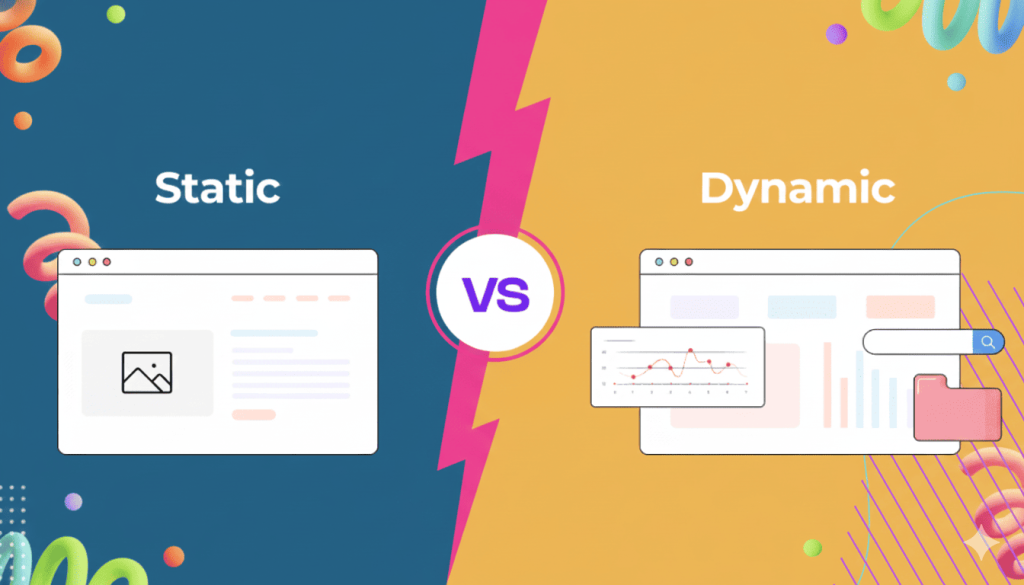
Essential DIFFERENCES BETWEEN STATIC VS DYNAMIC WEBSITE
Website Structure
Static websites use fixed HTML, CSS, and JavaScript files, while dynamic websites rely on servers, databases, and backend technologies.
Content Management
Static websites require manual code edits for updates, whereas dynamic websites enable easy content management through CMS or admin dashboards.
User Interaction
Dynamic websites support logins, forms, dashboards, and personalized experiences, while static websites offer limited or no user interaction.
Performance & Speed
Static websites load faster due to minimal server processing, making them ideal for high-speed, performance-focused projects.
Scalability & Growth
Dynamic websites scale easily with new pages, features, and users, while static websites become difficult to manage as content grows.
SEO & Content Marketing
Dynamic websites support blogging, keyword targeting, and regular updates, helping achieve long-term SEO growth compared to static websites.
Which Website Is Better for SEO?
Static websites are often preferred for technical SEO performance because they load extremely fast, have clean code, and minimal server processing. Faster page speed improves Core Web Vitals, reduces bounce rates, and helps search engines crawl pages more efficiently. For small business websites, landing pages, and service-based sites with limited content updates, static websites can rank very well for targeted keywords due to their simplicity and stability.
Dynamic websites, however, are better suited for long-term SEO growth and content scalability. They allow businesses to regularly publish blogs, add new pages, optimize content for multiple keywords, and improve internal linking all of which are important ranking factors. With built-in content management systems, dynamic websites make it easier to update content, add schema markup, and optimize on-page SEO, making them ideal for businesses focused on continuous organic traffic growth and higher search visibility.

HOW TO CHOOSE BETWEEN STATIC VS DYNAMIC WEBSITE
Choosing between a static and a dynamic website depends on your business objectives, content strategy, and future plans. If your goal is to create a simple online presence with fixed information such as services, contact details, or a company profile, a static website is often sufficient. It offers faster loading speed, lower development costs, and minimal maintenance, making it ideal for small businesses and informational websites.
Business Goals – Informational or interactive
Content Update Frequency – Rare or regular
SEO Requirements – Basic or advanced
Budget Considerations
Future Scalability Needs
However, if your business requires regular content updates, user interaction, blogging, or advanced SEO strategies, a dynamic website is the better choice. Dynamic websites support scalability, content management systems, and personalized user experiences, which help improve engagement and long-term search engine visibility.

FEATURES COMPARISON STATIC VS DYNAMIC WEBSITE
Static Website Features
A static website is designed with fixed content and a simple structure, which allows it to load extremely fast and remain highly secure. Since it does not rely on databases or server-side processing, development and hosting costs are lower, and maintenance is minimal. Static websites are easy to deploy, stable in performance, and best suited for portfolios, landing pages, and small informational websites where content rarely changes.
Dynamic Website Features
A dynamic website, on the other hand, is built to handle growing content and user interaction. It uses a database and a content management system to update content easily without coding. Dynamic websites support features like user logins, forms, dashboards, and personalized experiences. They are highly scalable, SEO-friendly for content marketing, and ideal for blogs, business websites, and eCommerce platforms that require frequent updates and long-term growth.
Web DEVELOPMENT COMPANY IN INDIA

Amunis Technologies is a leading static and dynamic website development company delivering high-performance, scalable, and SEO-friendly websites for businesses of all sizes. We specialize in building fast-loading static websites for brands that need simplicity and reliability, as well as powerful dynamic websites designed for growth, engagement, and long-term success. Every website we create is optimized for speed, security, and search engine visibility.
What sets Amunis Technologies apart is our commitment to business-driven solutions. As an experienced website development company, we understand that every business has unique requirements. That’s why we offer customized static and dynamic website development solutions tailored to your goals, industry, and budget helping you build a strong digital presence that converts visitors into customers.
Our team follows a strategic development approach, combining clean UI/UX design with robust backend architecture. Whether you need a lightweight static website for your business profile or a fully dynamic website with CMS, databases, and custom features, Amunis Technologies ensures seamless functionality across all devices. We focus on responsive design, optimized code, and future-ready technology to deliver websites that perform exceptionally well.
Frequently Asked Questions?
A static website shows fixed content, while a dynamic website changes content based on user interaction, databases, or backend logic.
Dynamic websites are generally better for SEO because they support frequent content updates, blogging, keyword targeting, and advanced optimization tools.
Yes, static websites are ideal for small businesses needing a fast, secure, and cost-effective online presence with minimal content updates.
Yes, a static website can be converted into a dynamic website by integrating databases, backend technologies, or a content management system.
Dynamic websites are better for long-term growth as they support scalability, content expansion, user engagement, and evolving SEO strategies.